01
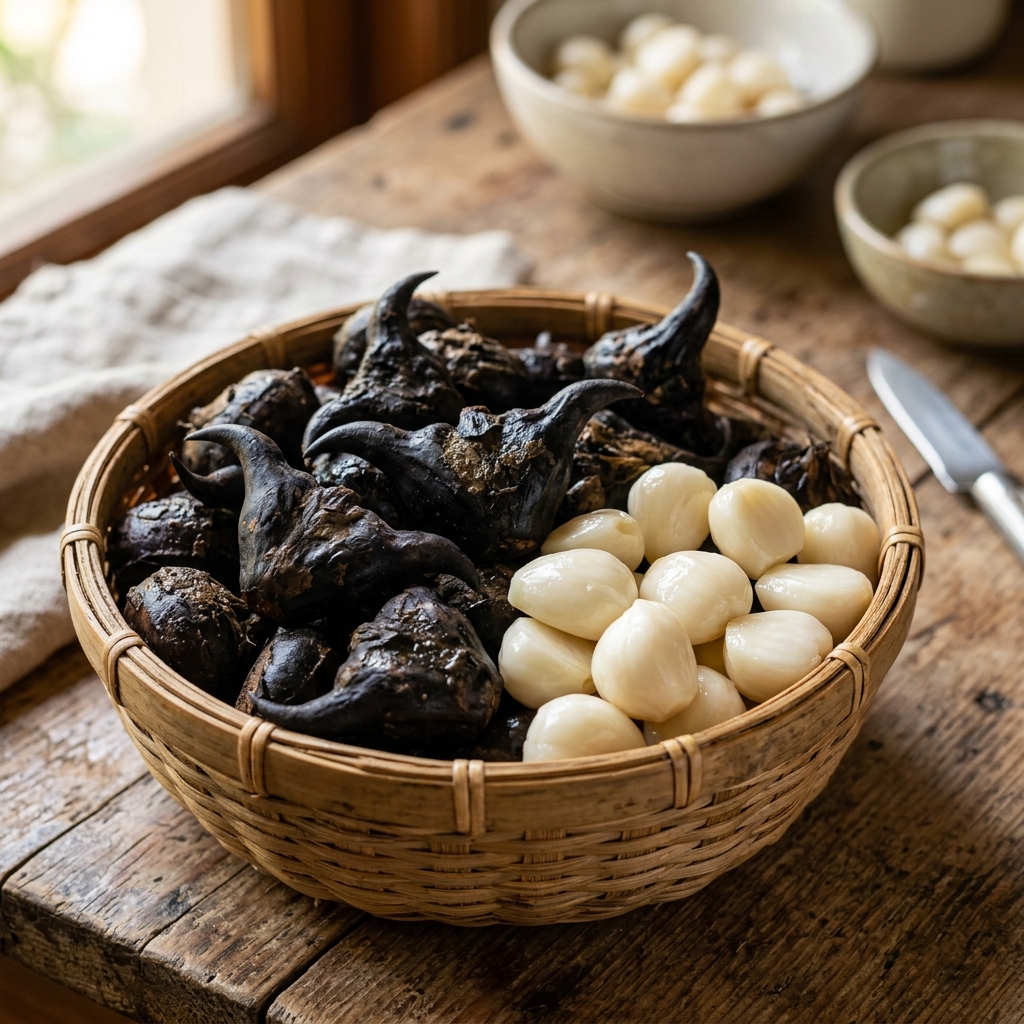
Boiled Spiced Singhara Street Snack
Tender boiled horned singhara sliced open and tossed with black rock salt (kala namak), chaat masala, and a squeeze of fresh lime.
During the crisp autumn and early winter months across South Asia, street markets fill with distinct, dark-horned aquatic fruits known as Singhara—commonly called Water Chestnuts (Trapa bispinosa or Trapa natans).
Despite its common English name, singhara is not a nut from a land tree. It is an aquatic floating herb that grows in freshwater lakes and ponds. Beneath its tough, dark purple-black horned shell lies a firm, crisp white kernel with a mildly sweet, refreshing taste similar to a cross between an apple and a coconut.
For centuries, singhara has held a special place in traditional Asian nutrition. When ground into flour (singhare ka atta), it serves as a nutrient-dense, naturally gluten-free staple.
Exploring the benefits of singhara reveals how this seasonal aquatic vegetable supplies concentrated potassium, dietary fiber, and protective polyphenols that support heart function, digestion, and daily hydration.
Scientific literature—including a comprehensive review published in Food Science & Nutrition (Adkar et al., PMID: 29339943)—establishes three primary physiological mechanisms behind singhara:
Singhara contains an exceptionally high potassium-to-sodium ratio. Delivering over 460mg of potassium per 100g serving with virtually zero sodium, singhara signals your kidneys to excrete excess fluid and sodium in urine. This relaxes arterial wall tension, supporting smooth cardiovascular circulation.
Unlike refined wheat or rice products, the carbohydrates in raw singhara and singhara flour consist largely of complex starches and resistant starch Type-3. This matrix resists rapid breakdown by amylase enzymes, producing a low-to-medium Glycemic Index (GI 54) that prevents sharp blood sugar spikes after meals.
Research published in the Journal of Ethnopharmacology (Liu et al., PMID: 37951203) highlights that singhara pericarp and kernels are rich in gallotannins, ellagic acid, and ferulic acid. These natural antioxidants help neutralize reactive oxygen species (ROS) in liver cells and protect stomach mucosal linings from acid irritation.
The table below outlines official nutritional values for 100 grams of raw peeled singhara (water chestnut kernel):
| Nutrient | Amount (per 100g) | Amount (per 100g raw peeled water chestnut) | % Daily Value (%DV) | Why Your Body Needs It |
|---|---|---|---|---|
| Energy / Calories | 97 kcal | 97 kcal | ~5% | Light, hydrating complex energy |
| Water Content | 74.0g | 74.0g | — | Preserves tissue fluid balance |
| Total Carbohydrates | 23.9g | 23.9g | ~8% | Slow-digesting complex starches |
| Dietary Fiber | 3.0g | 3.0g | 12% | Supports healthy bowel transit |
| Total Sugars | 4.8g | 4.8g | — | Gentle, low-glycemic sweetness |
| Protein | 1.4g | 1.4g | 3% | Small natural amino acid contribution |
| Fat Content | 0.1g | 0.1g | <1% | Virtually fat-free |
| Potassium (K+) | 468mg | 468mg | 10% | Relaxes blood vessel walls & balances sodium |
| Magnesium (Mg2+) | 22mg | 22mg | 5% | Supports cellular ATP energy synthesis |
| Vitamin B6 | 0.33mg | 0.33mg | 19% | Crucial for neurotransmitter balance |
Explore visual varieties and characteristics.
Because singhara grows in freshwater ponds, always scrub raw horned shells thoroughly under cold running water before cooking.
Boil whole singhara in water for 10 to 15 minutes to soften tough outer horn shells, allowing you to slice them open and pop out the crisp white kernels.
Use dried singhara flour (singhare ka atta) to make gluten-free flatbreads, pancakes, or porridges dense in potassium and resistant starch.
Eat freshly peeled raw singhara kernels for maximal crisp hydration, Vitamin B6, and heat-sensitive antioxidant gallotannins.
Traditional preparations and global recipes celebrating wholesome ingredients, balanced textures, and rich culinary heritage.
Tender boiled horned singhara sliced open and tossed with black rock salt (kala namak), chaat masala, and a squeeze of fresh lime.
Wholesome gluten-free flatbread made from finely milled water chestnut flour, mashed potatoes, and cumin, served warm with mint raita.
Sliced crunchy water chestnuts stir-fried with snow peas, baby corn, ginger, and sesame oil, retaining maximum crisp texture.
Roasted singhara flour gently cooked in pure ghee, green cardamom, almond milk, and a hint of jaggery for a traditional festive sweet.
Yes! Raw singhara and boiled water chestnuts have a moderate glycemic index (GI 54) paired with 3g of dietary fiber per serving. When eaten in moderate portions, singhara releases glucose gradually without causing sudden blood sugar spikes.
Sighara flour is 100% naturally gluten-free because water chestnuts are aquatic vegetables, not cereal grains like wheat or barley. It is an excellent flour alternative for individuals with celiac disease or gluten sensitivity.
Fresh raw singhara has a crisp, juicy texture and a subtle, refreshing sweetness similar to an apple, jicama, or fresh coconut meat. Boiled singhara becomes slightly softer and mealier, similar to a boiled sweet potato or chestnut.
Have a moment? Share your feedback or suggestions via Google to help us produce even higher quality, evidence-based nutrition guides.
No saved articles yet.
Click the bookmark button 🔖 inside any article to save it here for offline reading!

Hi! I am Mapple AI, your food science research companion. Ask me anything about biomolecules, organic diet patterns, or longevity recipes.