01
Mediterranean Watermelon, Feta & Mint Salad
Crisp cold cubed watermelon tossed with crumbled Greek feta cheese, fresh spearmint, kalamata olives, and a light lime-olive oil dressing.
Watermelon (Citrullus lanatus) is the quintessential summer superfruit, famous for its crisp sweetness and deep crimson flesh. Composed of 92% pure cellular water, watermelon is far more than a refreshing electrolyte treat. It is nature’s richest functional source of L-citrulline—a non-essential amino acid that serves as a direct precursor to nitric oxide—alongside concentrated lycopene, potassium, and Vitamin C.
Exploring the watermelon benefits (and general watermelon health benefits) reveals how this hydrating melon lowers aortic blood pressure, reduces arterial stiffness, alleviates post-workout muscle soreness, and supports kidney filtration according to published cardiology and sports medicine trials.
The remarkable physiological benefits of watermelon are governed by three primary clinical pathways:
In landmark double-blind clinical trials conducted at Florida State University and published in the American Journal of Hypertension (Figueroa et al. 2012, PMID: 22357723; 2014, PMID: 24572702), patients with prehypertension and Stage 1 hypertension supplemented with watermelon extract experienced:
In a randomized sports nutrition trial published in the Journal of Agricultural and Food Chemistry (Tarazona-Díaz et al. 2013, PMID: 23862566), athletes given unpasteurized watermelon juice 1 hour prior to high-intensity cycling experienced significantly reduced muscle soreness at 24 hours and lower post-exercise heart rates.
Watermelon contains higher concentrations of bioavailable lycopene (4532µg per 100g) than raw red tomatoes (3041µg per 100g). Lycopene neutralizes singlet oxygen free radicals, protecting vascular endothelial membranes from oxidative degradation and supporting prostate tissue health.
The nutritional breakdown below represents official data from the USDA FoodData Central database for 100 grams of raw diced watermelon compared to 1 typical cup serving (152g):
| Nutrient | Amount (per 100g) | Amount (per 1 cup diced watermelon (152g)) | % Daily Value (%DV) | Why Your Body Needs It |
|---|---|---|---|---|
| Calories | 30 kcal | 46 kcal | — | Light, hydrating, low-calorie fruit energy |
| Water Content | 91.4g | 139.0g | — | Preserves cellular volume & plasma hydration |
| Total Carbs | 7.55g | 11.5g | 4% | Easy-to-digest carbohydrates |
| Sugars | 6.20g | 9.42g | — | Natural fructose, glucose & sucrose |
| Dietary Fiber | 0.40g | 0.60g | 2% | Gentle soluble fiber |
| Protein | 0.61g | 0.93g | 2% | Contains functional amino acid L-citrulline |
| Total Fat | 0.15g | 0.23g | <1% | Virtually fat-free |
| GI / GL | — | 72 / 5 (Low GL) | High GI / Low GL | High GI, but very low Glycemic Load per serving |
| L-Citrulline | 150–300mg | 230–450mg | — | Potent nitric oxide precursor for vessel dilation |
| Lycopene | 4532µg | 6889µg | — | Higher lycopene concentration than raw tomatoes |
| Vitamin C | 8.1mg | 12.3mg | 14% | Immune defense & cellular protection |
| Potassium | 112mg | 170mg | 4% | Renal fluid balance & muscle relaxation |
The clinical reference matrix below details how fresh watermelon impacts cardiovascular, exercise, and metabolic health:
| Condition / Focus Area | Impact | General Guidance | Why (Mechanism + Verdict) |
|---|---|---|---|
| High Blood Pressure | Positive | Eat 2 cups daily or drink juice | Landmark clinical proof. Trial in Am J Hypertens (PMID: 22357723) showed watermelon L-citrulline significantly reduces central aortic blood pressure and wave reflection. |
| Muscle Soreness & Athletes | Positive | Drink 500ml fresh juice post-workout | Proven sports recovery. Clinical trial (PMID: 23862566) proved unpasteurized watermelon juice reduces 24-hour post-exercise muscle soreness and heart rate recovery. |
| Diabetes / Blood Sugar | Positive | Portion control: 1 cup per meal | Low Glycemic Load (GL 5). High GI (72) is offset by low total carbs per cup (11.5g). Eating 1 cup with protein maintains a stable glucose curve. |
| High Cholesterol | Positive | Eat daily as summer dessert | Lycopene vascular defense. High lycopene content (6889µg per cup) protects endothelial cell membranes and lowers oxidized LDL arterial plaque formation. |
| Weight Loss | Positive | Great low-calorie volumetric snack | Volumetric satiety. High water volume (92%) stretches stomach walls to trigger fullness signals for only 46 calories per full cup. |
| Pregnancy | Positive | Wash exterior rind; eat fresh | Hydration & Preeclampsia protection. Provides deep cellular hydration, alleviates heartburn, and delivers L-citrulline to support placenta blood flow. |
| Gut Health & Kidney | Positive | Eat fresh cold watermelon | Renal flushing & gentle digestive. High water and potassium content act as a mild natural diuretic, encouraging urine flow and renal flushing. |
| Kidney Disease (CKD) | Positive | Safe in standard portions | Low potassium load (112mg/100g). Safe for moderate renal diets compared to high-potassium fruits like bananas or papayas. |
| Oral Allergy Syndrome | Caution | Monitor if ragweed allergic | Cross-reactivity risk. Ragweed pollen sufferers may experience mild oral tingling from raw watermelon due to profilin protein cross-reactivity. |
| Pets (Dogs) | Positive | Remove seeds and hard outer rind | Hydrating dog treat. Seedless watermelon flesh is a safe, hydrating treat for dogs on hot summer days. Discard hard green rind to prevent blockages. |
| IBS (FODMAPs) | Avoid (High FODMAP) | Limit to ½ cup or avoid | High Fructose & Polyols. Contains excess fructose and mannitol, which can trigger gas, bloating, and loose stools in individuals with active IBS. |
Explore visual varieties and characteristics.
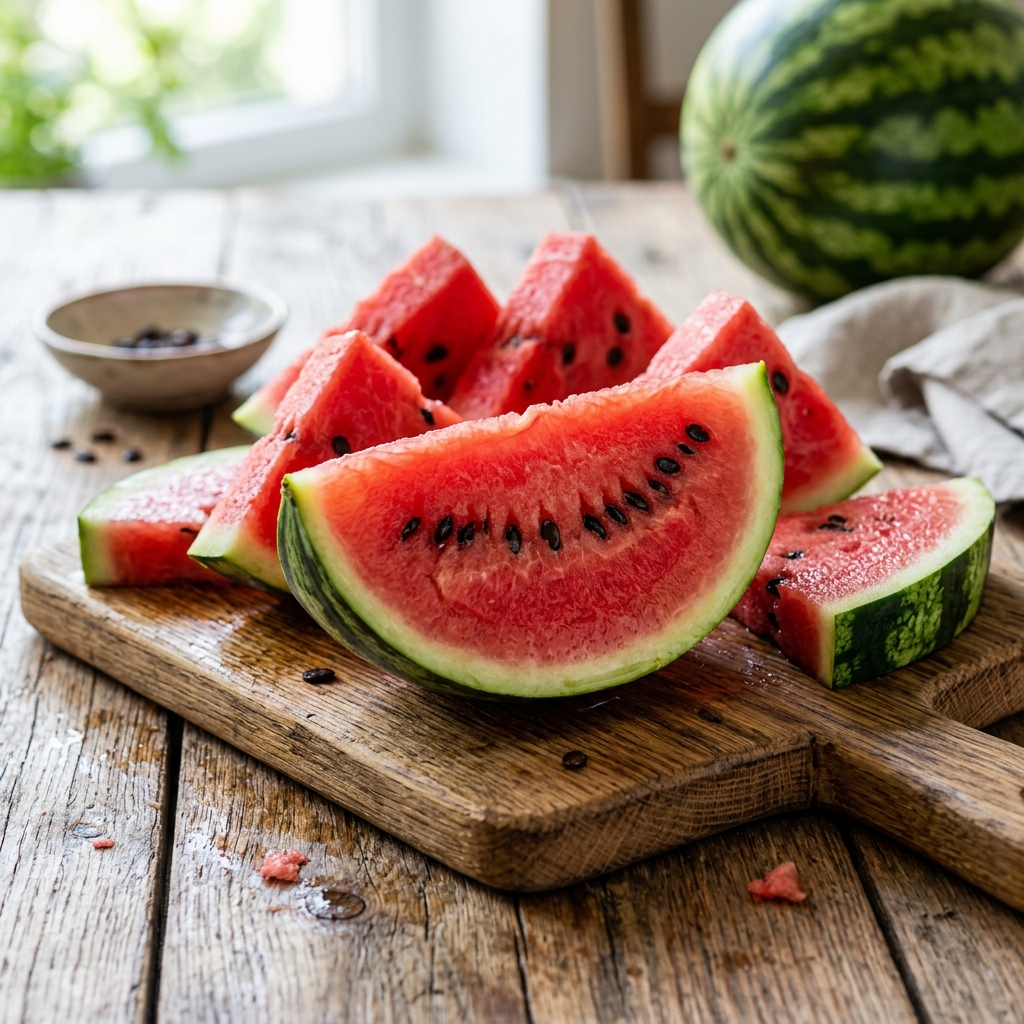
Don't discard the pale green and white rind; it contains the highest concentration of L-citrulline and can be blended into fresh smoothies or pickled.
Drink 1 to 2 cups of fresh watermelon juice 1 hour prior to intensive training to optimize nitric oxide blood flow and minimize next-day muscle soreness.
Enjoy 1 to 1.5 cups of fresh diced watermelon alongside raw almonds or walnuts to balance its high glycemic index with a low glycemic load.
Store whole melons at room temperature to preserve carotenoid levels; cover sliced melon tightly and refrigerate for up to 4 to 5 days.
Traditional preparations and global recipes celebrating wholesome ingredients, balanced textures, and rich culinary heritage.
Crisp cold cubed watermelon tossed with crumbled Greek feta cheese, fresh spearmint, kalamata olives, and a light lime-olive oil dressing.
Fresh watermelon flesh blended with cold spring water, freshly squeezed lime juice, and a touch of mint over crushed ice.
Crisp white inner watermelon rinds simmered in apple cider vinegar with cloves, ginger, and allspice for a traditional gut-friendly condiment.
Pure blended fresh watermelon and green rind juice mixed with coconut water and a pinch of Himalayan pink salt for natural electrolyte replenishment.
L-citrulline is a natural amino acid that your body converts into L-arginine and nitric oxide gas ($NO$). Nitric oxide relaxes and widens blood vessels, lowering aortic blood pressure, reducing arterial stiffness, and increasing blood flow to working muscles (PMID: 22357723).
Yes, in controlled portions! Although watermelon has a high Glycemic Index (**GI 72**), its total carbohydrate content per cup is very low (11.5g), resulting in a **Low Glycemic Load (GL 5)**. Eating 1 cup of watermelon with nuts or protein will not cause sharp glucose spikes.
Clinical trials (PMID: 23862566) show that drinking fresh watermelon juice 1 hour before exercise reduces 24-hour muscle soreness because L-citrulline speeds up ammonia and lactic acid clearance from muscle tissue.
Yes! The white inner rind of watermelon is 100% edible and contains even higher concentrations of L-citrulline and dietary fiber than the sweet red flesh. You can blend the white rind into smoothies or saute it in stir-fries.
The nutrition in watermelon makes it the ultimate refreshing, low-calorie treat! One full cup of diced fresh watermelon (152 grams) contains only **46 calories** and **9.4 grams of natural fruit sugar**, while providing a massive **139 grams of pure cellular water** (92% by weight). Watermelon is packed with heart-healthy antioxidants—delivering **6,889µg of lycopene** (higher than raw red tomatoes!), 12.3mg of Vitamin C, 170mg of potassium, and natural **L-citrulline** to support healthy blood vessel dilation.
Have a moment? Share your feedback or suggestions via Google to help us produce even higher quality, evidence-based nutrition guides.
No saved articles yet.
Click the bookmark button 🔖 inside any article to save it here for offline reading!

Hi! I am Mapple AI, your food science research companion. Ask me anything about biomolecules, organic diet patterns, or longevity recipes.